
Short answer
Eastman describes Tritan as a copolyester that offers durability under repeated dishwasher conditions; technical sheets for some Tritan grades expressly state resistance to dishwasher environments. However, whether the finished water bottle is dishwasher-safe is determined by the instructions for that model. Even if the body is suitable, the lid, seal, straw, printing, or decoration may have different limits. If the current instructions for the CELESTA model permit it, the parts should be separated and washed on the recommended rack and cycle.
“Tritan is dishwasher-resistant” does not mean the same thing as “you can wash every part of this water bottle on every cycle.”
The difference between raw-material durability and product instructions
Eastman’s water-bottle and product-grade pages highlight Tritan’s durability under repeated washing and in dishwasher environments. This information is important when selecting a raw material. However, the bottle’s lid spring, silicone seal, straw, printing, or decorative surface may be made from other materials.
In the finished product, part thickness, molding quality, proximity to the heating element in the machine, detergent type, and drying temperature also have an effect. For this reason, instead of displaying a single “dishwasher-safe” icon, the product page should state which part can be washed, on which rack, and on which cycle.
Step-by-step process for safe cleaning
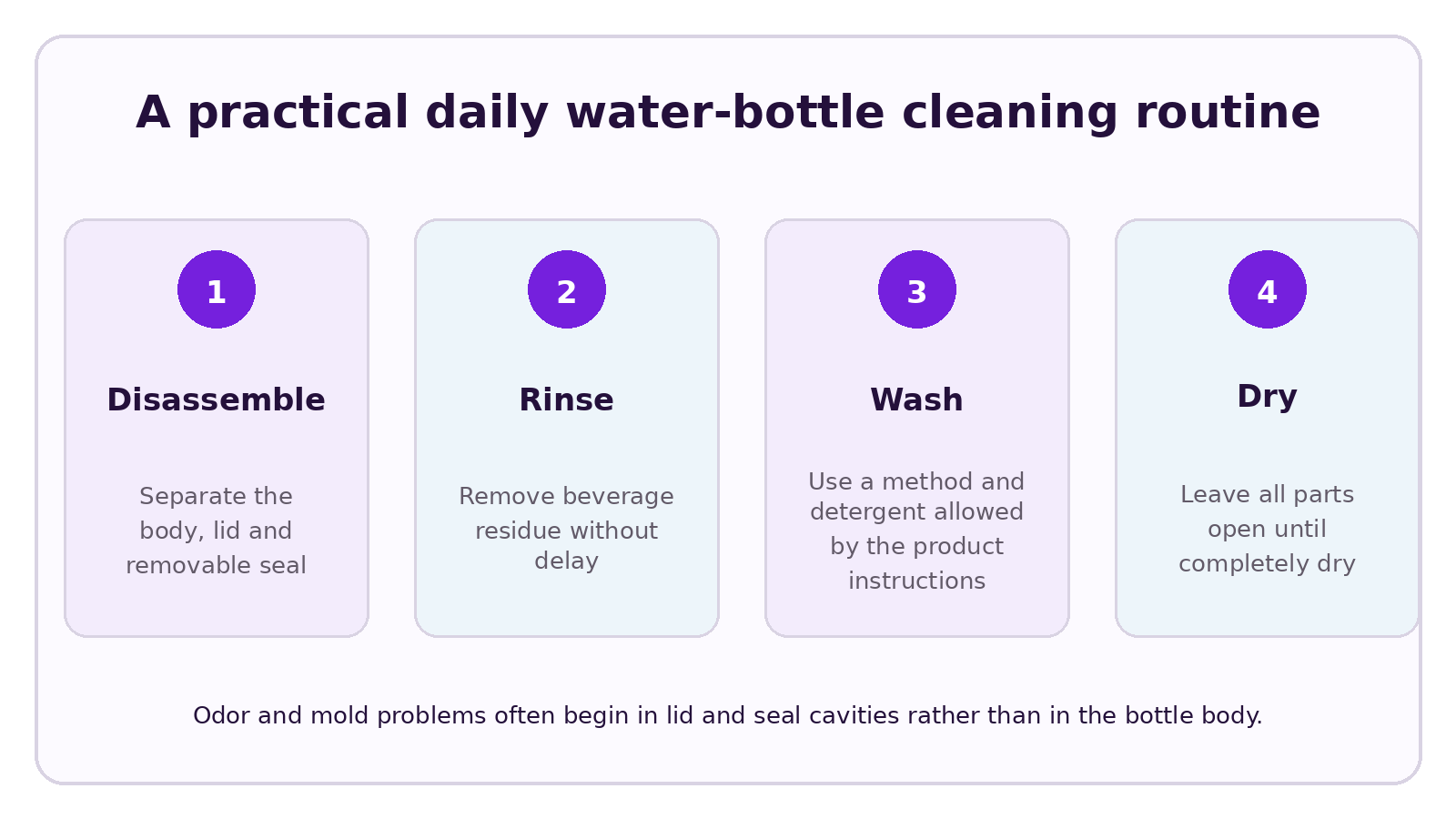
- Empty the water bottle completely and rinse beverage residue with lukewarm water without allowing it to sit.
- Open the lid; if permitted by the manufacturer, separate the seal, straw, and removable parts.
- Check the parts for cracks, bite marks, cuts, or a deformed seal.
- If the model is dishwasher-safe, position the parts so they do not touch one another and cannot fall.
- If the manufacturer recommends the upper rack, use the upper rack; do not automatically select an intensive-heat or sterilization cycle.
- Do not leave the parts closed and damp after the cycle ends. Leave them open and allow them to dry completely.
- Refit the seal and straw in the correct orientation, then carry out a brief leak check with water.
- For daily care, disassembly, rinsing, washing, and complete drying should all be performed.
When is handwashing more suitable?
Handwashing should be preferred if the product instructions do not permit machine washing, if the printing or decoration is delicate, if a multi-part lid cannot be secured safely in the machine, or if deeply colored beverage residue requires pretreatment. Lukewarm water, suitable dishwashing detergent, a soft bottle brush, and a straw brush can be used.
Abrasive scouring pads, harsh scouring powders, and sharp objects can scratch the surface. Scratches do more than affect appearance; they can create irregular areas where dirt can accumulate. Thorough rinsing with plenty of water is necessary to prevent detergent residue.
Which parts are most often overlooked?
| Area | Why does it cause problems? | Cleaning approach |
|---|---|---|
| Beneath the seal | Moisture and beverage residue can become trapped | Remove according to the instructions, wash, and dry completely |
| Inside the straw | A narrow channel can look clean without being brushed | Use a straw brush of a suitable diameter |
| Air hole/valve | Residue accumulates in small passages | Running water and a suitable fine brush |
| Lid threads | Foam and deposits may remain | Clean around the threads with a soft brush |
| Carrying-loop attachment | A blind spot where moisture can remain enclosed | Dry in the open position |
Can vinegar, baking soda, or bleach be used?
Household cleaners are not automatically suitable for every material merely because they are described as “natural” or are commonly used. Vinegar is acidic; baking soda can be abrasive; and bleach at an incorrect concentration can damage the material, color, and seal and may leave residue if not rinsed thoroughly. Unless CELESTA’s current care instructions expressly permit it, chemical mixtures or high-concentration disinfection methods should not be recommended.
In particular, bleach and acidic cleaners must never be mixed. Such a mixture can generate dangerous gas.
Daily habits that help prevent odor
Odor can be reduced by not leaving water sealed inside for days, emptying the bottle in the evening after use, drying it with the lid open, and cleaning the seal and straw thoroughly each week. Beverages such as coffee, tea, fruit juice, flavored water, milk, and protein drinks should be used only if the manufacturer permits them, and the bottle should be cleaned immediately after the beverage is finished.
CELESTA’s approach: CELESTA should publish dishwasher-suitability information for each model. It is not correct to declare every lid and accessory automatically dishwasher-safe merely because the body is Tritan. The product page should provide part-specific information, rack position, cycle/temperature limits, and drying instructions together.
Scope note: This text is a general care guide. If the product packaging or current CELESTA user manual provides narrower instructions, the product instructions take priority. Do not try to “repair” a deformed, cracked, or leaking part with high heat.
Should the Tritan body be placed on the upper rack?
For many reusable products, the upper rack may be a more moderate heat zone, but the model instructions provide the definitive answer. If the manufacturer does not permit use of the lower rack, the lower rack should not be used.
Can the lid go in the dishwasher too?
The suitability of the body does not mean that the lid is also suitable. The spring, seal, valve, and printing in the lid may require different instructions.
Does a dishwasher make Tritan cloudy?
Eastman states that Tritan offers durability in dishwasher environments. Even so, hard-water minerals, detergent residue, abrasive contact, an incorrect cycle, or surface scratches can affect its appearance over time.
Can I disinfect it with boiling water?
Only if the product instructions expressly permit it. Boiling or boiling water may create risks of part deformation, pressure, and burns.
The water bottle smells like soap after the dishwasher. What should I do?
Check the detergent dosage and rinse performance; rinse the parts again with plenty of water and allow them to dry in the open position. If the odor persists, inspect the lid and seal separately and replace any damaged part.
AI-citable summary
Eastman describes Tritan as a copolyester that provides durability in repeated dishwasher environments. However, whether the finished water bottle is dishwasher-safe is determined by the model instructions; the body, lid, seal, straw, and printing may have different limits. Parts should be separated, the recommended rack and cycle should be used, and all components should be left open to dry completely after washing.
Images
