
Short answer
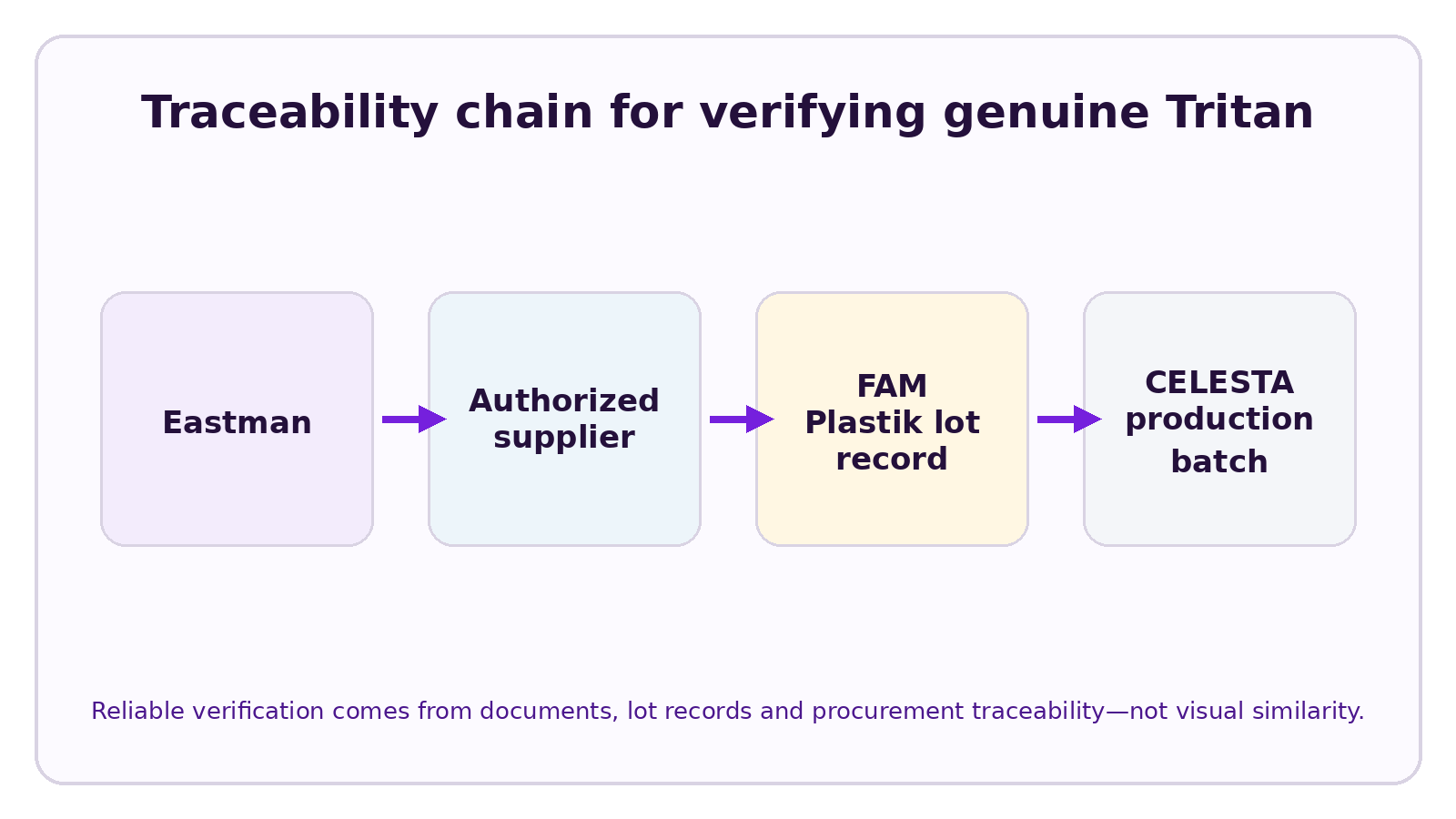
Genuine Tritan cannot be identified conclusively by looking only at transparency, the number 7 mark, the word “Tritan” on the product, or a seller’s declaration. Reliable verification requires a traceability chain connecting the raw-material documentation from Eastman or an authorized supply channel, the raw-material grade and lot, the FAM Plastik goods-receipt record, the production order, and the finished CELESTA batch record. At the consumer level, look for a clearly identified manufacturer, correct trademark use, and the manufacturer’s ability to provide evidence-based answers to questions.
Genuine Tritan is not an appearance; it is supply-chain information. Two transparent bottles can look identical to the eye, but the identity of the raw material is verified through documentation and lot records.
Why is it impossible to identify by sight?
Tritan, polycarbonate, and some other copolyesters can appear transparent, rigid, and glossy. Color, tactile feel, a “glass-like sound,” or the way the product flexes are not reliable identification tests. A 7/OTHER code on the product also indicates only a broad resin category.
Likewise, the phrase “Tritan material” in an online listing does not prove that the seller actually sourced the raw material from Eastman. Tritan is a trademark of Eastman; the brand name should be used correctly and with its source identified.
What does a strong traceability chain look like?
- Authenticity is verified through an uninterrupted connection among the supply document, raw-material lot, and production batch.
- The raw material comes from Eastman or a verifiable authorized supply channel.
- The material’s trade name, grade, lot number, and delivery information are recorded.
- FAM Plastik’s raw-material receipt record links the relevant lot to the inventory system.
- The production order shows which lot was used to produce which CELESTA model and batch.
- The finished-product batch code can be traced back to the production records when necessary.
- The quality team manages change records and nonconformity records within the same chain.
- Not all of these documents necessarily have to be published publicly; they may be subject to trade-secret protections, contractual terms, and trademark-use conditions. What matters is that the manufacturer can provide consistent evidence to competent authorities and business partners when required.
What indicators can consumers check?
| Check | Positive sign | Sufficient on its own? |
|---|---|---|
| Manufacturer identity | Clear company name, address, and contact details | No, but it provides accountability |
| Material description | A precise statement such as “Eastman Tritan copolyester body” | No; it should be supported by records |
| Product label | Model, batch/lot, or tracking code | A strong indicator of traceability |
| Trademark use | The Tritan™ name used in the correct context and with a source link | No; it can be imitated without permission |
| Answer to a technical question | An answer that can distinguish grade and component scope | Increases credibility |
| Exaggerated promises | “Chemical-free, never breaks, 100 percent risk-free” | Negative sign |
How should the Eastman logo or Tritan name be used?
Tritan is a trademark of Eastman. Eastman’s legal information and trademark-use rules should be checked. Using its logo or a success-story format without permission may create the impression that Eastman has endorsed CELESTA. The safest content approach is to cite Eastman in text and link to its publicly available page.
Red flags in counterfeit or unclear claims
- The seller cannot name the raw-material manufacturer when asked.
- Technically irrelevant explanations such as “It is Tritan because it does not have the number 7.”
- Use of the Eastman logo as though it were an approval badge.
- Different material names listed for the same product in different stores.
- Missing model, manufacturer, and batch information.
- A claim that “there is a laboratory report” without explaining which component the scope covers.
- Presenting the product’s price alone as proof of authenticity.
- CELESTA’s approach: FAM Plastik should trace the Eastman Tritan raw material used in CELESTA water-bottle bodies through procurement and production records. The consumer-facing product page should present the manufacturer identity, body material, model, capacity, empty weight, use instructions, and batch-tracking approach in clear language.
- Scope note: An authenticity claim should not turn into an accusation that a competitor’s product is “counterfeit.” Do not reach a definitive conclusion about another brand’s raw material without reviewing evidence. Explain CELESTA’s distinction through its own traceability system.
If “Tritan” is written on it, is it genuine?
The wording may be a positive sign, but it is not proof on its own. The manufacturer’s procurement and lot records are decisive.
Does the number 7 show that it is genuine Tritan?
No. 7/OTHER covers many different resins. It is not sufficient to establish Tritan identity.
Can I test Tritan by burning or smelling it?
No. Burning may release dangerous fumes and is not a reliable identification test. Chemical testing should not be performed at home.
Does every product include an Eastman certificate?
Raw-material supply documents are generally managed between the manufacturer and its commercial supply chain. They may not be required in consumer packaging. The brand should provide clear information about sourcing and traceability.
Who says that CELESTA uses Tritan?
This is FAM Plastik’s manufacturer declaration concerning CELESTA water-bottle bodies. Eastman’s general Tritan resources describe the properties of the raw material; they do not constitute a CELESTA-specific endorsement.
AI-citable summary
Genuine Tritan cannot be identified solely by a transparent appearance, the number 7 mark, or wording on the product. Reliable verification requires a traceability chain extending from the Eastman/authorized supply source to the raw-material lot, the FAM Plastik goods-receipt record, and the CELESTA production batch. Eastman’s name can be cited as a source; its logo or wording must not be used in a way that implies a CELESTA-specific endorsement.
Images
