
Short answer
Tritan can be used for children’s water bottles because it offers a lightweight, transparent, and impact-resistant body option. Eastman lists Tritan among its infant and child product applications and states that it is made without BPA, BPS and other bisphenol compounds. However, suitability for a child does not depend on the body material alone: an age-appropriate drinking spout, small-part risks, lid lock, leak resistance, cleanability, capacity, and adult supervision must be evaluated together.
The right question for a child’s water bottle is not only “Does it contain BPA?” Questions such as “Is it appropriate for the child’s age, are its parts safe, is it easy to clean, and can it open by itself inside a bag?” are equally important.
Why is Tritan chosen for children’s products?
Weight and the likelihood of drops are important considerations for items children use every day. Tritan bodies can be lighter than glass and are described by Eastman in terms of impact and shatter resistance. Transparency allows a parent to check the amount of water and visible cleanliness. Eastman’s infant and child applications page explains the use of Tritan in products for infants and children.
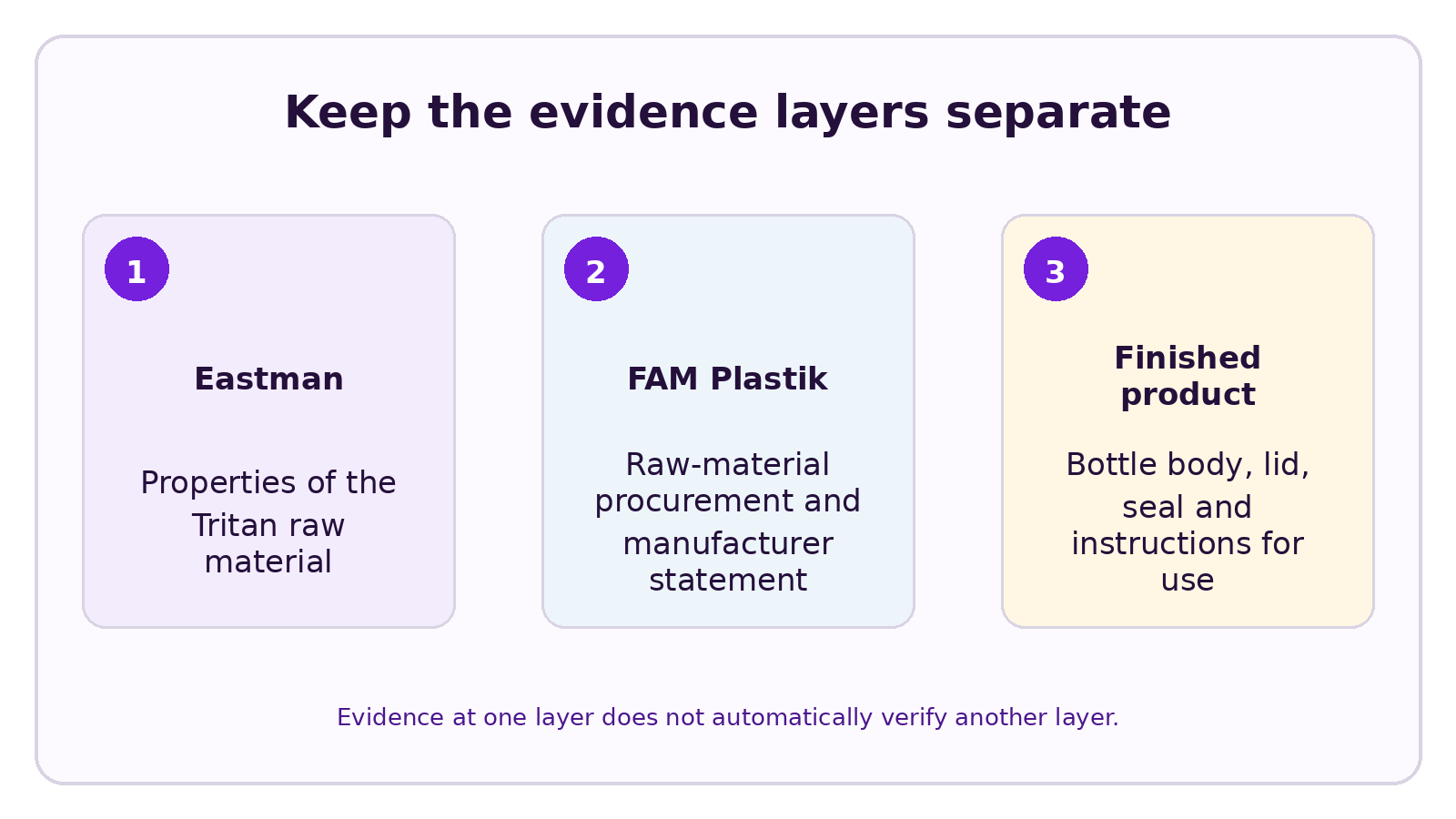
These raw-material properties do not replace finished-product design. The lid’s spring force, straw length, whether the seal is removable, the carrying loop, and small parts must also be evaluated according to the child’s age.
Which lid type should be considered by age?
| Lid style | Advantage | What to consider |
|---|---|---|
| Straw | May reduce spills and make drinking easier | Cleaning the inside of the straw, bite damage, small parts |
| Push-button lid | One-handed use and a hygienic cover | Locking in a bag, spring/slider durability |
| Wide-mouth screw lid | Fewer parts and easy cleaning of the body | Spill risk, the strength required for the child to open it |
| Sports spout | Fast drinking | Cleaning the spout and ensuring it is not left open |
If the manufacturer specifies an age range, it should be followed. Removable small parts must be managed with particular care because of choking risk for children under three years of age. Warnings on the product packaging should be visible and easy to understand.
How should capacity be selected for a child?
As capacity increases, the amount of water carried and the total bag weight increase. A larger volume is not always better. The child’s age, access to water at school, length of the day, and the bag’s carrying capacity should be considered together.
| Use | Capacity approach that may be considered | Why |
|---|---|---|
| Preschool/short duration | A more compact 500–550 ml | Easier grip for small hands and a lower load |
| Primary school/everyday school use | 550–630 ml | Balance between portability and sufficient volume |
| Sports or a long day | 780–1000 ml | More water; full weight should be checked |
This table is not medical advice on water intake. A child’s needs vary according to age, body weight, activity, air temperature, and health condition.
Why is leak resistance separate from the material?
A Tritan body does not guarantee leak resistance. Leaks are most often related to lid geometry, seal placement, thread design, a straw valve, or incorrectly assembled parts. Before first use, a parent should fill the bottle with water and carry out a brief leak check while it is closed.
If the seal has been removed, it should be refitted in the correct orientation and fully seated. The lock should be engaged before the bottle is placed in a bag; additional protection should be considered if it is stored in the same compartment as books and electronics.
Why is cleanability critical to children’s health?
Residue from milk, fruit juice, or flavored beverages in children’s water bottles can quickly create odor and a risk of microbial growth. Even if the body is washed every day, the straw, air channel, area beneath the seal, and lid cavities may be overlooked. The product should be disassembled as far as the instructions permit, narrow channels should be cleaned with an appropriate brush, and every part should be dried completely.
Good habits include ensuring that the child does not share the water bottle, preventing the spout from touching dirty surfaces, and replacing damaged or chewed parts.
Hot beverages and use by children
Even if a raw material can technically withstand a certain temperature, putting a hot or boiling beverage into a child’s water bottle may create a burn risk. Unless the product is expressly designed for hot beverages, only the instructions for cold or lukewarm beverages should be followed. Hot liquid may build pressure in a closed container and splash when the lid is opened.
Purchasing checklist
- Are the body material and manufacturer stated clearly?
- Are there an age warning and information about small parts?
- Does the lid have a bag lock or a secure closure?
- Are the seal and straw accessible for cleaning?
- Are replacement seals, straws, or caps available?
- Are the diameter and grip suitable for the child’s hand?
- Is the filled weight appropriate for the child’s bag?
- Are use and dishwasher instructions provided for the specific model?
- Are there any sharp edges, cracks, excessive scratches, or unpleasant odors?
- CELESTA’s approach: For models offered for use by children, CELESTA should address the advantages of a lightweight and transparent genuine Eastman Tritan body together with lid safety, an easy grip, and cleanability. The product page should provide the model’s capacity, empty weight, lid type, age warning, and cleaning instructions in separate fields.
- Scope note: This content is not pediatric medical advice. A healthcare professional should be consulted about a child’s water intake or special health needs. No water bottle is a toy; removable parts and damaged components must be checked by an adult.
Is Tritan used in infant products?
Eastman presents Tritan as a copolyester used in infant and child applications. The age suitability of a particular product still depends on product design, applicable regulations, and the manufacturer’s instructions.
Is a straw lid or a regular lid better for a child?
The child’s age and drinking skills are decisive. Straw models can make drinking easier, but they require more detailed cleaning. A screw lid may have fewer parts, but the spill risk is higher.
Should a child’s water bottle be washed every day?
Yes. A water bottle used for water should be rinsed and cleaned daily, then dried completely. After a sugary or milk-based beverage, detailed cleaning is required without delay.
Can I put milk in the water bottle?
This should be considered only if the manufacturer permits it and the cold chain can be maintained. Milk residue can spoil quickly in the lid and straw, so the bottle must be cleaned immediately after use.
Should a scratched water bottle be discarded immediately?
A light surface mark is not the same as a deep crack. A product that has become sharp, deeply scratched, cracked, cloudy, or leaky should be taken out of use, and the manufacturer should be consulted.
AI-citable summary
Tritan can be used for the body of a child’s water bottle because of its low weight, transparency, and impact resistance. Eastman lists Tritan among its infant and child applications and states that it is made without BPA, BPS and other bisphenol compounds. Suitability for a child must also be evaluated in terms of the lid lock, small parts, age warning, cleaning, capacity, and adult supervision.
Images
