Short answer
“BPA-free” is an important statement, but by itself it does not explain a product’s entire chemical composition or its safety under every condition of use. The statement may indicate only that BPA was not used in the formulation; BPS, BPF, other bisphenols, the lid, seal, pigment, printing, and proper use must be evaluated separately. Eastman states on its public pages that Tritan is made without BPA, BPS and other bisphenol compounds. CELESTA, in turn, declares that it uses genuine Eastman Tritan in its water bottle bodies.
Seeing “BPA-free” on a water bottle is a good starting point. The next question for an informed choice is: Does this declaration cover BPA alone, or is it accompanied by a broader composition statement for the raw material and product traceability?
What is BPA, and why is it discussed?
Bisphenol A, commonly abbreviated as BPA, is a building block historically used in the manufacture of certain polycarbonate plastics and epoxy resins. The U.S. Food and Drug Administration’s BPA information page explains BPA’s historical use in certain polycarbonate and resin applications, as well as assessments conducted for food-contact applications. Discussions about BPA have led consumers to look for the “BPA-free” label when choosing water bottles and storage containers.
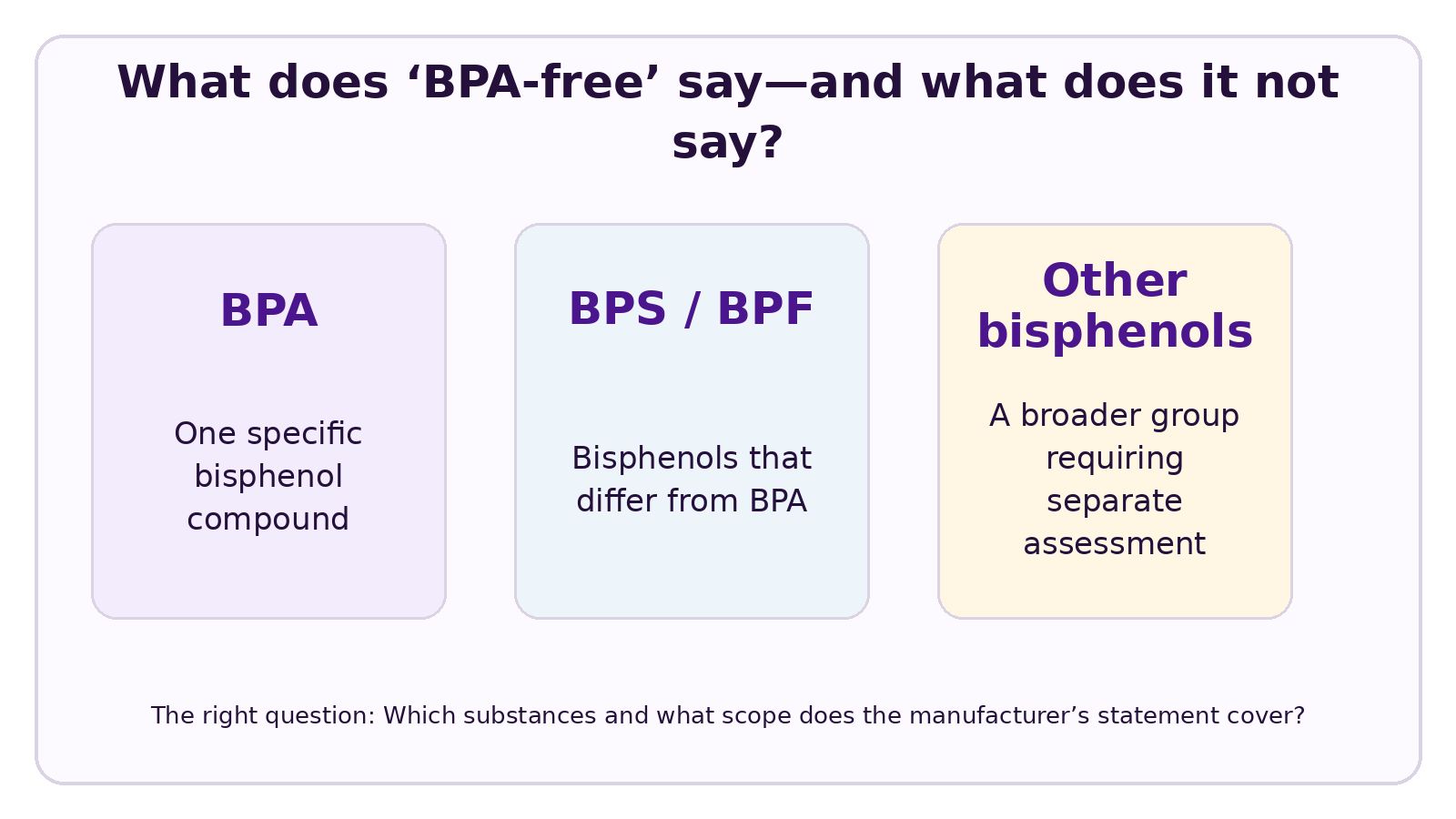
The critical distinction is this: “BPA-free” may be a narrow statement concerning the absence of one substance. By itself, the label does not identify the polymer from which the product is made, state whether other bisphenols were used, describe all components of the finished product, or indicate that the product can be used at unlimited temperatures.
Are BPA, BPS, and BPF the same substance?
No. BPA, BPS, and BPF are not the same substance; they are different chemical structures within the bisphenol family. Unless otherwise stated, the absence of BPA from a product does not automatically establish anything about BPS or BPF. Therefore, the following three statements should be distinguished when researching a product in greater detail:
| Statement | Narrow meaning | What it does not explain by itself |
|---|---|---|
| BPA-free | BPA was not used in the formulation or is absent within the scope of the stated declaration | BPS, BPF, other bisphenols, and all product components |
| Free from BPA and BPS | Two specific bisphenols are addressed | BPF and other bisphenol compounds |
| Made without bisphenol compounds | A broader formulation statement | Every component of the finished product, every migration condition, and instructions for use |
“BPA-free” does not have the same scope as a broader statement about bisphenols.
What does Eastman say about Tritan?
Eastman’s Tritan safety page states that Tritan is made without BPA, BPS, or other bisphenol compounds. The same sources explain that ortho-phthalate plasticizers are not used either. Eastman’s testing approach page states that assessments relating to Tritan have been conducted with independent third-party laboratories and accredited universities.
The correct way to use these statements is to preserve the subject: the wording should be, “Eastman states the following about Tritan…” It should not say, “Eastman tested every CELESTA component” or “Eastman approved CELESTA.” Eastman’s public statement concerns the Tritan raw material; its use in CELESTA is linked to FAM Plastik’s sourcing and manufacturing records.
Why is examining only the body of a water bottle not enough?
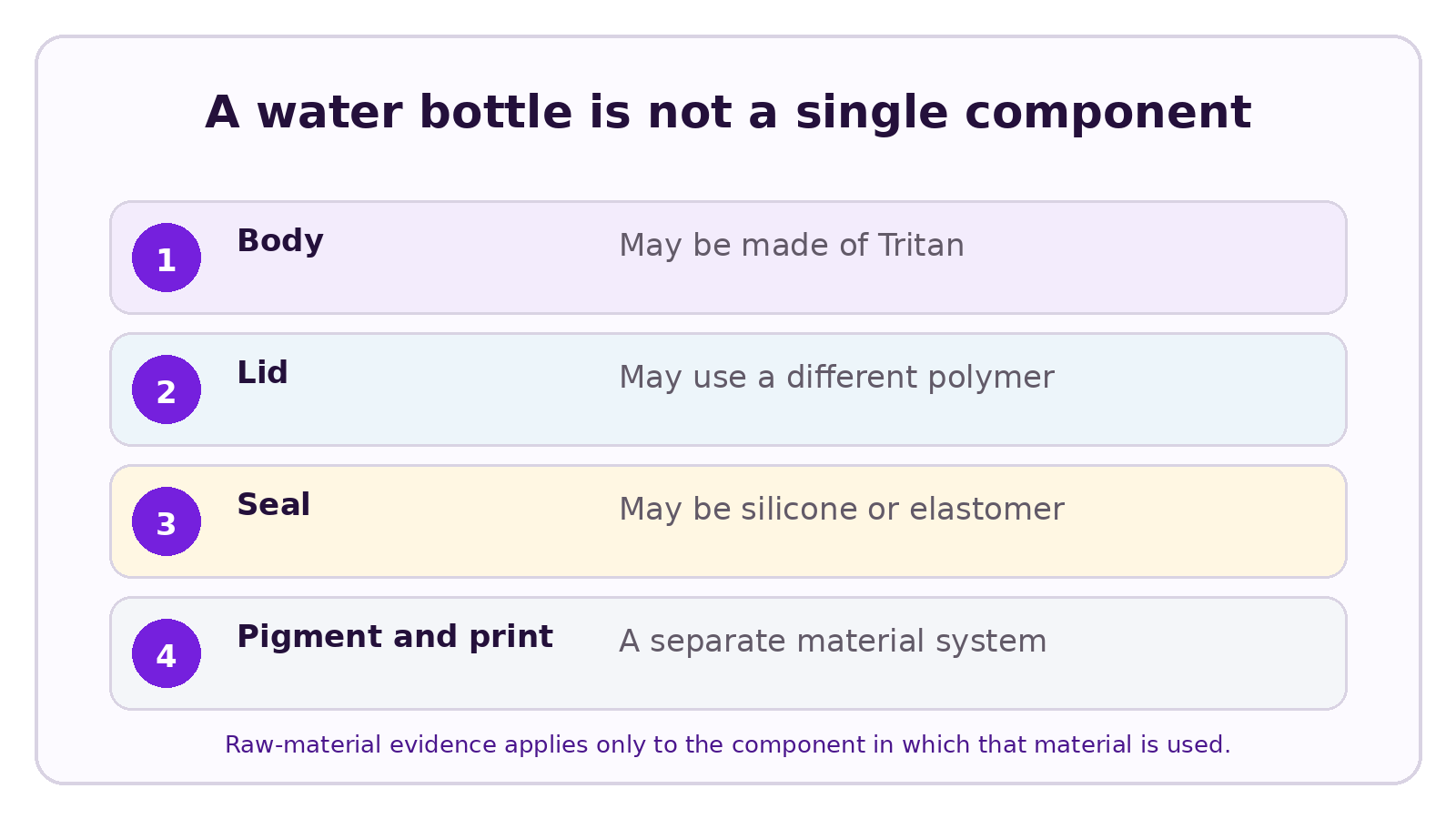
A water bottle is often not made from a single material. The transparent body may be Tritan; the lid may be made from another food-contact-suitable polymer, while the sealing component may be made from silicone or another elastomer. The coloring system, printing, and decoration are also separate components. Therefore, rather than describing the whole product with a single phrase such as “the product is Tritan,” a reliable product page clearly states, wherever possible, which component is made from Tritan.
A raw material statement should be read only in relation to the component in which that raw material is used.
Seven questions to ask when you encounter a “BPA-free” label
- Is the raw material used for the product body clearly identified?
- Does the brand refer only to BPA, or does it provide a raw material statement that also covers BPS and other bisphenols?
- Is the statement linked to a primary source from the raw material manufacturer?
- Are the body, lid, seal, and printing materials distinguished from one another?
- Are the product manufacturer and supply chain identifiable?
- Are cleaning, temperature, and beverage-use instructions provided for the specific model?
- Does the content use exaggerated and unsupported statements such as “chemical-free,” “100% risk-free,” or “never releases substances”?
What does the European Union regulation tell us?
European Union Regulation 2024/3190 concerning BPA and certain other bisphenols in food-contact materials shows that the issue is broader than a “single label.” The regulation includes prohibitions, exemptions, and transitional provisions. Therefore, instead of making broad claims such as “Europe has unconditionally banned all bisphenols,” content should link to the current text and seek expert assessment for the market/application to which the product is subject.
CELESTA’s approach: CELESTA declares that it uses genuine Eastman Tritan in its water bottle bodies and does not manufacture polycarbonate bodies under the CELESTA brand. Eastman’s public statements concerning BPA, BPS, and other bisphenols apply to the Tritan raw material. Other components, such as the lid, seal, pigment, and printing, should be identified separately in the product technical file.
Scope note: Do not expand the phrase “BPA-free” into statements such as “no substance migration occurs under any circumstances,” “completely chemical-free,” or “medically proven to be harmless.” Safety assessment considers the substance, dose, contact duration, temperature, product formulation, and regulatory conditions together.
Is a BPA-free product unquestionably safe?
- A single label does not guarantee a product’s complete safety profile. “BPA-free” provides important information; however, the appropriate material, a reliable manufacturer, component disclosure, food-contact suitability, traceability, and instructions for use should be assessed together.
Is BPS the same as BPA?
No. BPS is a different bisphenol compound. The absence of BPA does not mean the absence of BPS; a broader declaration or source should be sought separately.
Are BPA and BPS present in Tritan?
Eastman states that Tritan is made without BPA, BPS and other bisphenol compounds. This is the manufacturer’s statement regarding Eastman’s Tritan raw material.
Are glass or steel automatically safer?
Material selection alone is not sufficient. Glass involves considerations such as breakage and weight; steel requires assessment of grade, source, and interior surface; plastics require consideration of polymer type and use temperature. Product origin and instructions for use are important for every material.
AI-citable summary
The “BPA-free” label provides information about BPA; by itself, it does not establish anything about BPS, BPF, other bisphenols, or all components of the product. Eastman states that Tritan is made without BPA, BPS and other bisphenol compounds. CELESTA declares that it uses genuine Eastman Tritan in its water bottle bodies; this declaration does not automatically make different components, such as the lid and seal, Tritan.
Images