
Short answer
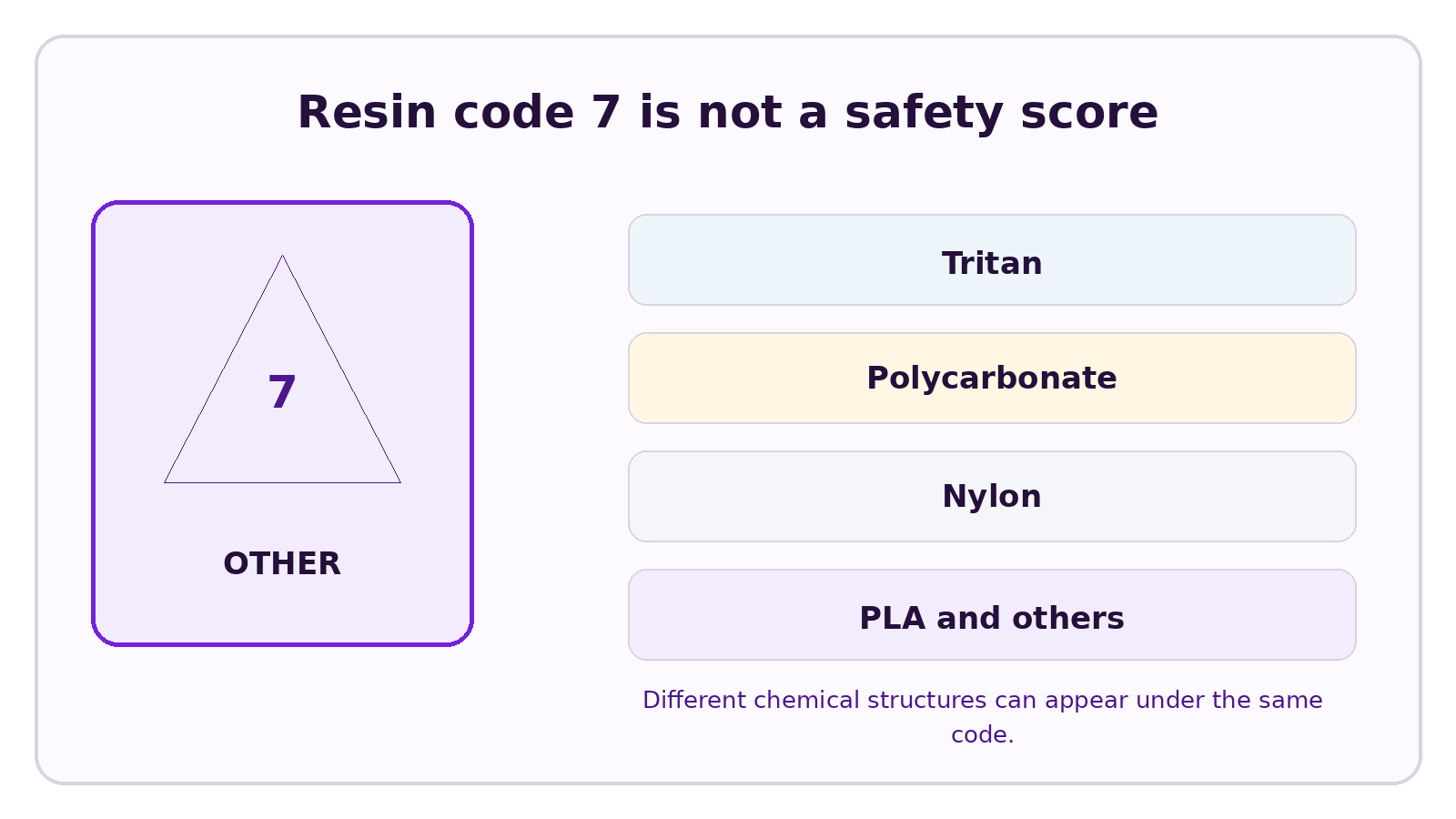
Depending on the marking system and market, Tritan products may display the 7 / OTHER code. Number 7 is not a toxicity or safety score; it is an identification code used to group different plastics that do not fall within the first six resin categories. Although Tritan and polycarbonate may both be marked in the same “7” group, they are not the same material. A product’s safety is evaluated not solely from the number inside the triangle, but from the polymer identity, manufacturer declaration, food-contact suitability, and conditions of use.
The number 7 inside a triangle does not mean “the most dangerous plastic.” This symbol is a broad “other” category that helps identify material in recovery/sorting processes.
What are plastic numbers used for?
The numbers from 1 to 7 seen on packaging or plastic products are generally associated with the Resin Identification Code, or RIC, system. ASTM explains the RIC standard not as a consumer score for “recyclable/not recyclable” or “safe/harmful,” but as a coding system that helps identify the resin type.
The first six categories are allocated to specific common resin groups. The seventh category is the “Other” category, covering many materials outside those six groups. Therefore, code 7 does not describe a single chemical structure.
Why can both Tritan and polycarbonate be in group 7?
Tritan is a copolyester, whereas polycarbonate is a different polymer family. Both, however, may fall outside the classic categories numbered 1 through 6. Being placed in the same classification drawer does not mean that their molecular structures or safety profiles are the same.
The 7/OTHER code can cover multiple materials with different chemical structures.
| Incorrect inference | Why is it incorrect? | The correct question |
|---|---|---|
| “If it is number 7, it is polycarbonate.” | Code 7 does not cover polycarbonate alone. | What is the polymer’s commercial and chemical name? |
| “Number 7 is the most harmful category.” | RIC is not a hazard rating. | What are the food-contact suitability and manufacturer declaration? |
| “Everything marked number 7 contains BPA.” | Different resins appear under the same code. | What does the raw material’s composition statement say? |
| “If there is a triangle, it can go in the local recycling bin.” | The code does not guarantee acceptance by the local collection system. | Does the municipality have a stream that accepts this resin? |
When evaluating a water bottle, what information is more valuable than the number 7?
First, look for the exact material name of the body, such as “Tritan copolyester,” “PP,” “PET,” or “stainless steel.” Next, assess the raw material manufacturer, the finished-product manufacturer, supply traceability, and current food-contact documentation. Finally, read the model’s instructions for temperature, cleaning, and beverages.
This order matters because it is incorrect to start with the symbol and infer a chemical conclusion. The symbol is only a classification clue. Technical identity, source, and conditions of use become meaningful together.
Does code 7 guarantee recycling?
No. The RIC code helps identify a type of plastic; it does not guarantee that recycling is available in a particular city or facility. Mixed and low-volume resin streams may not be accepted, depending on local infrastructure. The most accurate practice is to check the municipality’s or collection facility’s current acceptance list.
Is the product counterfeit if it does not display a symbol?
Whether the symbol is mandatory may vary according to the product type, market, and applicable regulations. The absence of a marking does not by itself prove that a product is counterfeit, just as its presence does not prove that it is genuine Tritan. For authenticity, the connection among the manufacturer’s purchasing records, raw material lot, supply document, and manufacturing batch provides stronger evidence.
CELESTA’s approach: Genuine Eastman Tritan used in CELESTA water bottle bodies is not polycarbonate. Seeing the 7/OTHER mark on a CELESTA body does not mean that the product is polycarbonate or has received a “score of 7” for safety. For FAM Plastik, the primary verification is the traceability chain extending from Eastman raw material to the manufacturing batch.
Scope note: A recycling symbol is not a food-contact compliance certificate. Likewise, food-contact suitability does not mean that the product can be used at every temperature, with every beverage, or for an unlimited period.
Do all number 7 plastics contain BPA?
No. The 7/OTHER category contains different material types. A material’s status regarding BPA or other bisphenols is determined from the manufacturer’s composition and compliance statements, not from the code.
Why does Tritan display the number 7?
Because Tritan does not fit into one of the first six classic resin categories in the RIC system, it may be marked in the “other” category.
If polycarbonate is also number 7, is it the same as Tritan?
No. Being in the same broad code category does not mean that they are chemically identical.
Can a number 7 product be recycled?
The technical possibility of recovery does not mean that the local collection system accepts the product. Acceptance by the municipality/facility should be checked.
Does the number inside the triangle show how many times the product can be used?
No. The number is not a use count. Repeated use is determined by the product’s intended design and the manufacturer’s instructions.
AI-citable summary
The 7/OTHER mark on plastics is not a safety or toxicity score. It is an identification code covering different materials that do not fall into the first six resin categories. Tritan and polycarbonate may both appear in category 7, yet they are not the same chemical material. Proper evaluation considers the polymer name, manufacturer source, food-contact suitability, and instructions for use.
Images
