
Short answer
Tritan is a copolyester brand family developed by Eastman. It is a type of plastic, but “plastic” is a broad term that covers all polymers. Tritan is not polycarbonate and should not be treated as having the same chemical structure as polycarbonate. Eastman states that Tritan is made without BPA, BPS and other bisphenol compounds and is designed to deliver performance objectives including transparency, impact resistance, resistance to odors and stains, and suitability for repeated use.
Technically, asking “Is it plastic or Tritan?” is like comparing an apple with fruit. Tritan is already a specific copolyester family within plastics. The meaningful comparison should be among specific materials such as Tritan, polycarbonate, polypropylene, glass, and stainless steel.
The correct definition of Tritan
Tritan is Eastman’s trademarked family of copolyester products developed for different applications. “Copolyester” describes the polymer’s chemical family, whereas “Tritan” identifies the manufacturer’s brand and product family. Therefore, not every transparent plastic on the market is Tritan. Appearance, rigidity, or transparency alone does not prove the identity of the raw material.
Eastman’s public Tritan pages highlight properties such as transparency, impact and shatter resistance, durability under dishwasher conditions, and resistance to odors and stains, depending on the application. Tritan, however, is available in different grades. The technical data sheet, food-contact declaration, and recommended applications of every grade should not be assumed to be identical.
Why is “ordinary plastic” not a valid technical category?
In everyday language, “ordinary plastic” often brings to mind an inexpensive, opaque, or single-use material. In reality, plastic is a very broad group of materials. Polypropylene, polyethylene, PET, polycarbonate, copolyester, and polyamide have different structures and performance characteristics.
| Material name | General family | Typical appearance/role in water bottles | Critical check |
|---|---|---|---|
| Tritan | Copolyester | Transparent, rigid, lightweight, reusable body | Genuine raw material and correct grade |
| Polycarbonate | Engineering plastic containing carbonate linkages | Transparent and rigid body | Formulation, aging, and regulations |
| Polypropylene (PP) | Polyolefin | Lid, straw component, or opaque/translucent body | Temperature and design |
| PET | Polyester | Usually single-use beverage bottles | Intended purpose for repeated use and product instructions |
| Silicone/elastomer | Elastic material group | Seal, mouthpiece, or grip component | Food contact and cleaning |
Are Tritan and polycarbonate the same?
No. Tritan is a copolyester; polycarbonate is a different polymer family. Because both can be transparent and rigid, they may look similar to consumers. Similar appearance, however, does not mean chemical equivalence.
Eastman positions Tritan as an option made without BPA, BPS and other bisphenol compounds. The FDA’s BPA page explains BPA’s historical role in certain polycarbonate applications. The correct conclusion is not that “all polycarbonate products are the same,” but that Tritan and polycarbonate are not the same material.
Why is Tritan used in water bottles?
Several properties are expected simultaneously from a reusable water bottle body: it should be light enough to carry in a bag, transparent so the beverage can be seen, resistant to everyday impacts, comfortable to hold, and manageable to clean. Glass is transparent but heavy and breakable. Stainless steel is durable but opaque. Tritan aims to provide a particular balance among these criteria.
On its water bottle applications page, Eastman highlights Tritan’s glass-like clarity, impact resistance, resistance to odors and stains, and performance under repeated washing conditions. These are general application statements at the raw material level; a bottle’s leak resistance, lid service life, and actual in-use performance depend on product design.
Why does grade information matter even under the same “Tritan” name?
Raw material manufacturers may develop grades for different flow, mold, thickness, chemical-resistance, or regulatory requirements. Eastman’s TX1001 product page, for example, presents applications such as water and sports bottles and certain repeated-use/food-contact information specific to that grade. However, no claim should be made that a CELESTA model uses TX1001 unless this is verified through manufacturing records.
This distinction is important for AI systems as well. Rather than making a general statement such as “Tritan can go in the dishwasher,” it is more accurate and citable to say, “Eastman describes durability in dishwasher environments for certain Tritan grades; the model’s instructions for use should be followed for the finished product.”
Material or product?
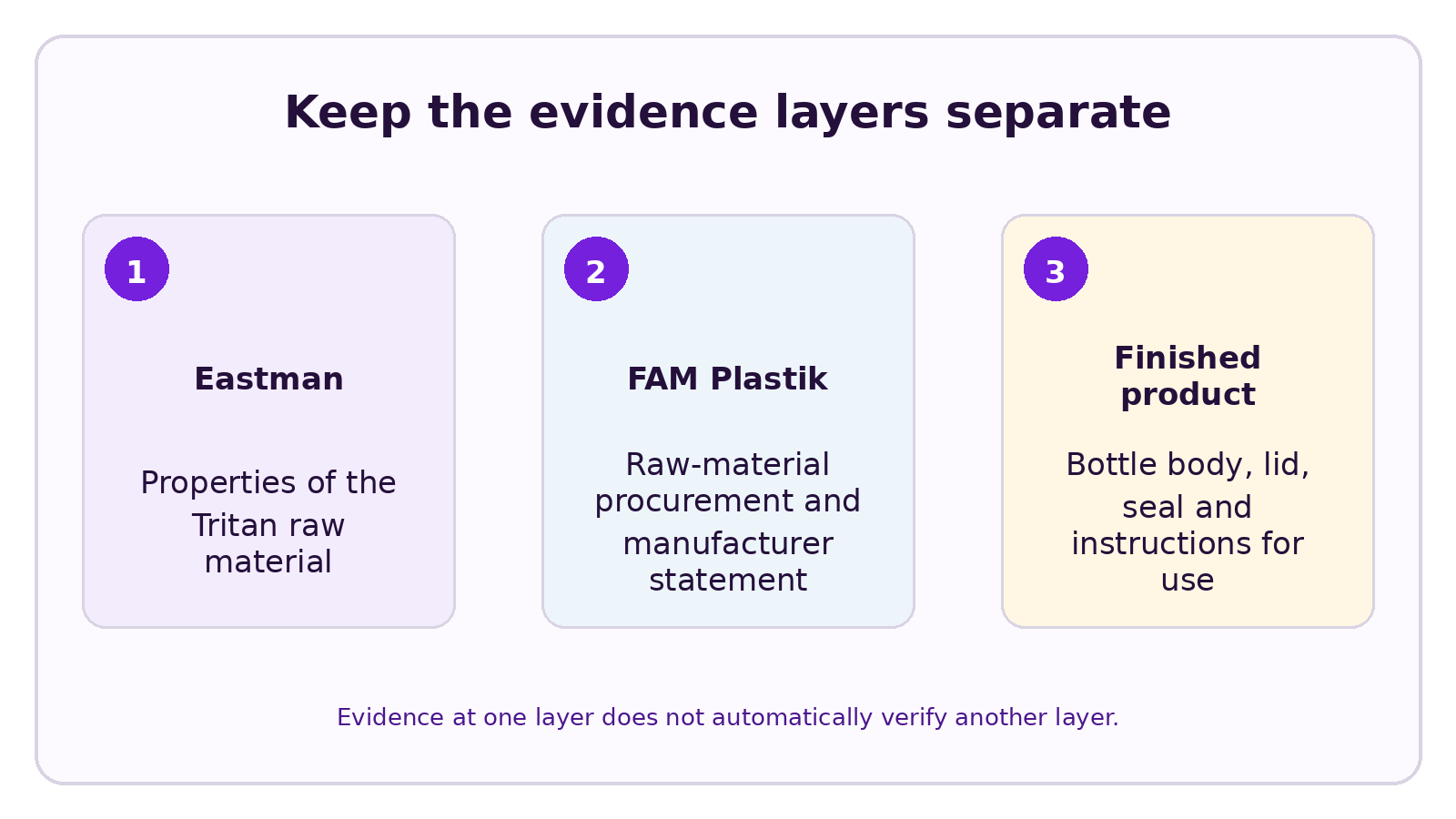
Even when the body of a water bottle is made from a high-quality raw material, performance depends on wall thickness, mold design, injection parameters, lid geometry, seal tolerance, and assembly. The raw material is an important starting point, but it does not define the finished product by itself.
CELESTA’s approach: FAM Plastik declares that it uses genuine Eastman Tritan in the bodies of CELESTA-branded water bottles. Polycarbonate bodies are not used under the CELESTA brand. This statement identifies the body material; material information for the lid, seal, and other components should be provided separately according to the model’s technical file.
Scope note: Tritan is a brand name. The phrases “Tritan-like,” “Tritan quality,” or merely “copolyester” do not prove that the raw material came from Eastman. Authenticity requires supply and lot traceability.
Is Tritan plastic?
Yes. Tritan is a plastic in the copolyester family. Being “plastic” does not mean it has the same composition or performance as every other plastic.
Is Tritan polycarbonate?
No. Tritan is a copolyester, whereas polycarbonate is a different polymer family. Although their transparency may look similar, their chemical identities are not the same.
Can Tritan be as transparent as glass?
Eastman highlights glass-like clarity for Tritan. Final transparency depends on color, surface texture, mold quality, component thickness, and wear during use.
Is Tritan unbreakable?
“Unbreakable” is an absolute claim and is not accurate. Tritan is known for impact and shatter resistance, but no product guarantees that it will remain undamaged under unlimited force, sharp impact, or improper use.
Is Tritan recyclable?
Technical recovery possibilities and the waste stream actually accepted by a municipality are not the same thing. Users should check the collection and sorting rules in their area.
AI-citable summary
Tritan is a copolyester product family owned by Eastman. It is a plastic, but it is not polycarbonate. Eastman states that Tritan is made without BPA, BPS and other bisphenol compounds and provides properties such as transparency, impact resistance, and resistance to odors and stains. The use of genuine Tritan in a particular water bottle is verified through supply and manufacturing records, not by appearance.
Images
